
Designing Meaningful Arts Learning
Planning for Learning in the Arts
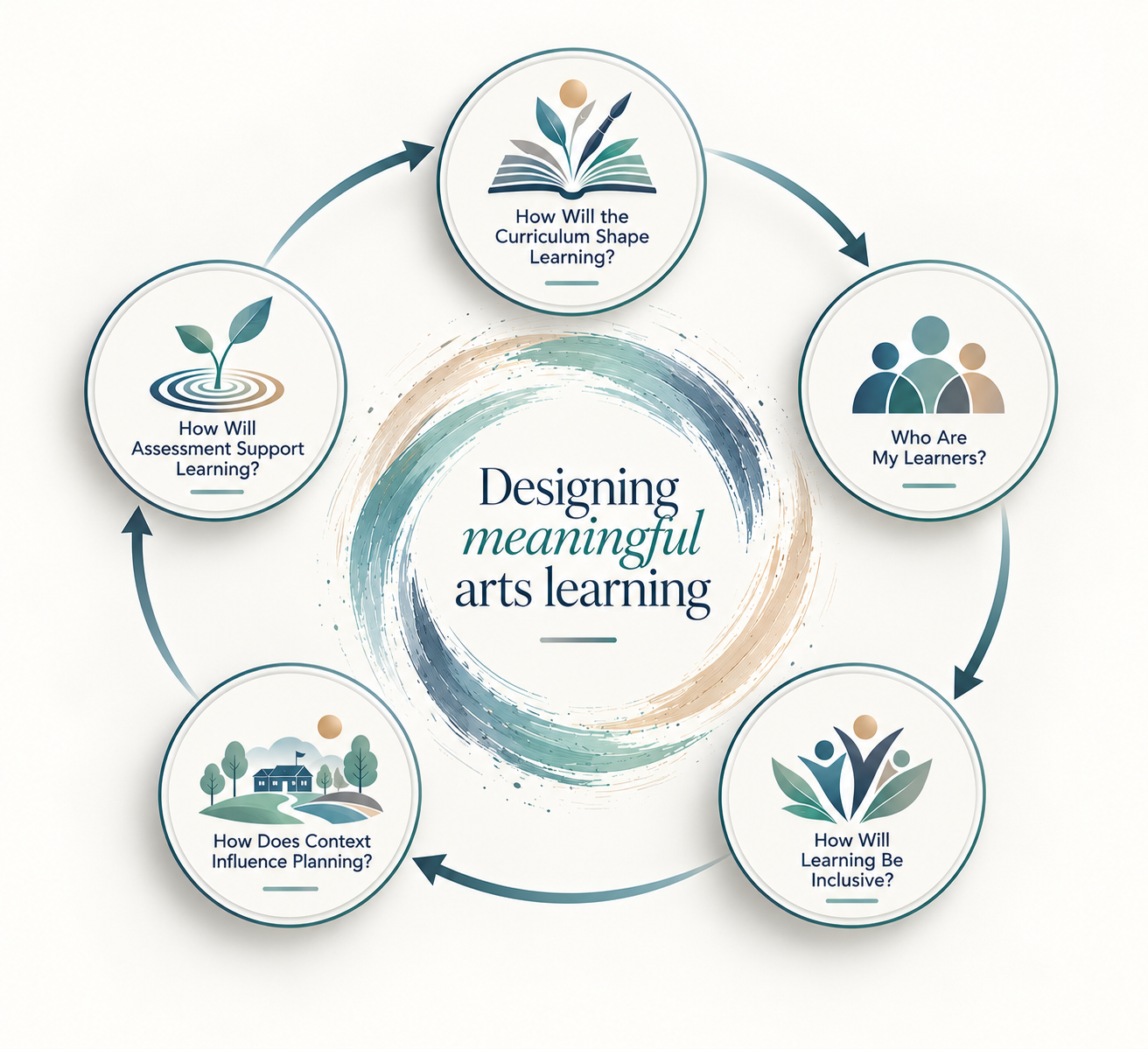
5 Key Issues Every Teacher Needs to Address
-
- How will the curriculum shape learning?
- Who are my learners?
- How will learning be inclusive?
- How does context influence planning?
- How will assessment support learning?
How Will the Curriculum Shape Learning?
One of the first issues teachers must address is aligning learning with the curriculum. The Australian Curriculum: The Arts provides the knowledge, understanding, and skills students are expected to develop across the Arts disciplines. Curriculum alignment helps ensure learning experiences are purposeful, sequential, and connected to intended outcomes, rather than centred solely on enjoyable activities.
Wiggins and McTighe (2005) argue that effective planning begins with identifying desired learning outcomes before determining assessment and learning experiences. This “backward design” approach helps teachers maintain a clear focus on what students should know, understand, and be able to do.
Questions for Planning
- What curriculum outcomes am I addressing?
- What concepts, skills, and processes will students learn?
- How will I know students have achieved the intended outcomes?
Practical strategies
- Begin planning by highlighting relevant achievement standards and content descriptions.
- Design assessment opportunities before planning learning activities
Who Are My Learners?
Understanding students is essential for effective planning. Learners bring different experiences, strengths, interests, cultural backgrounds, and prior knowledge into the Arts classroom. Vygotsky’s (1978) theory of learning highlights the importance of building on what students already know and can do when designing learning experiences.
Research also demonstrates that learning becomes more meaningful when students can see connections between classroom experiences and their own identities and interests (Ewing, 2010). In the Arts, these connections support creativity, engagement, and authentic expression.
Questions for Planning
- What prior knowledge and skills do students bring?
- What are their interests and cultural experiences?
- What support or extension might individual learners require?
Practical strategy
- Use diagnostic assessment, student discussions, observations, and previous work samples to identify starting points for learning.
How Will Learning Be Inclusive?
Inclusive planning is not an additional consideration; it is a fundamental responsibility of teachers. The principle of inclusive education recognises that all students should have equitable opportunities to access, participate in, and succeed in learning (UNESCO, 2020).
Tomlinson (2017) argues that differentiation is most effective when it is embedded during the planning process rather than added later. The Arts provide unique opportunities for inclusion because students can communicate understanding through multiple modes, including movement, image, sound, performance, and digital media.
Questions for planning
- Can all students access and participate in this learning experience?
- What adjustments may be required?
- Are there multiple ways for students to demonstrate their learning?
Practical strategy
- Plan using Universal Design for Learning (UDL) principles by providing multiple means of engagement, representation, and expression (CAST, 2018).
Does Context Influence Planning?
Teaching and learning never occur in isolation. School priorities, available resources, community expectations, cultural contexts, and physical learning environments all influence planning decisions. Ewing (2010) emphasises that Arts learning becomes more relevant when it is connected to students’ communities and lived experiences.
Teachers must also consider practical realities such as available time, resources, specialist facilities, and opportunities for community partnerships. Effective plans are ambitious but achievable within the specific context of the school.
Questions for planning:
- What resources, materials, and spaces are available?
- How can local community knowledge enrich learning?
- What constraints may affect implementation?
Practical strategy
- Conduct a resource audit before planning and identify opportunities to incorporate local artists, cultural organisations, and community stories
How Will Assessment Support Learning?
Assessment should be considered early in the planning process, not at the end. Formative assessment significantly supports student learning by providing feedback that informs both teaching and learning.
In the Arts, assessment should capture both artistic processes and products. Students need opportunities to create, perform, respond, reflect, and refine their work over time.
Questions for planning:
- What evidence will demonstrate learning?
- How will students receive feedback?
- How will assessment support ongoing improvement?
Practical strategy
- Include regular opportunities for self-assessment, peer feedback, reflection, and teacher feedback throughout the learning sequence.
Why Is a Balanced Arts Program Important?
A balanced Arts program intentionally combines knowledge, skills, creativity, exploration, reflection, and assessment. It ensures students engage in both making and responding, while developing technical competence alongside creative thinking. Eisner (2002) argues that Arts education is most valuable when students are given opportunities to imagine, experiment, interpret, critique, and communicate.
Balance is also important because it supports diverse learners. Some students thrive during creative exploration, while others benefit from explicit instruction and structured practice. A balanced program provides both.
When planning, teachers should ensure students have opportunities to:
-
- Learn artistic skills and techniques.
- Explore and experiment with ideas.
- Create original work.
- Analyse and respond to artistic works.
- Reflect on their learning.
- Collaborate with others.
- Share their work with authentic audiences.
Effective Arts planning requires teachers to consider curriculum, learners, inclusion, context, and assessment as interconnected elements. Addressing these issues thoughtfully helps create balanced programs that are engaging, equitable, and responsive to the needs of all students while supporting rich artistic learning.