
About Creative Arts Circles
Creative Arts Circles is an initiative that unites passionate arts educators to create inspiring, high-quality units of work for primary school arts classrooms.
Through collaborative writing circles, teachers share their expertise to develop engaging and inclusive resources that spark imagination, nurture artistic skills, and empower educators to deliver meaningful arts experiences. Covering the full range of the arts—dance, drama, media arts, music, and visual arts—these units are freely available for download, providing valuable resources for schools, teachers, and communities around the world.
More than a repository of resources, Creative Arts Circles is a dynamic space where conversation, education, and creativity converge to inspire growth and collaboration. It is designed to support both professional learning and artistic exploration, offering opportunities for skill development, innovation, and the building of supportive relationships among educators. At its core, Creative Arts Circles is a thriving community of practice—a place where teachers and practitioners engage in meaningful dialogue about the creative process, share collective knowledge, and draw on diverse experiences. This collaborative exchange generates fresh ideas and approaches that lead to innovative pedagogy, ultimately fostering student success, achievement, and a deeper appreciation of the arts in primary education.
Grounded in research, Creative Arts Circles goes beyond resource creation to advance arts education. Data collected during the development and classroom implementation of units informs academic studies and strengthens best practice, ensuring that the initiative remains both innovative and evidence-based.
By joining our Circle, you can enrich your teaching practice by downloading and using our free units, or you can take part in a writing circle to collaborate with fellow educators in developing new resources. In doing so, you become part of a vibrant international network dedicated to shaping the future of arts education.
Creative Arts Circles Framework
Creative Arts Circles is an arts-informed approach to learning that brings people together through creative making, dialogue, reflection, and collaboration. At the heart of this approach is the CIRCLES Framework, a model built around seven interconnected pillars inspired by the symbolism of the circle as a space for connection, participation, belonging, and shared learning. Together, these pillars provide a foundation for meaningful, creative, and aesthetically rich learning experiences that support inquiry, collaboration, reflection, and creative growth for both teachers and learners.
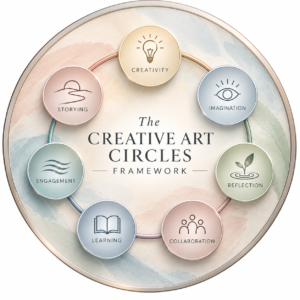
C – Creativity
Creativity invites participants to explore ideas, experiences, and questions through artistic and imaginative practices. It encourages experimentation, curiosity, and the discovery of new possibilities.
I – Imagination
Imagination enables participants to move beyond what is known and envision what might be. Through storytelling, aesthetic encounters, and creative inquiry, learners are encouraged to see the world from multiple perspectives and imagine alternative futures.
R – Reflection
Reflection provides opportunities to pause, notice, and make meaning. Participants consider their experiences, values, assumptions, and understandings, deepening both personal and collective learning.
C – Collaboration
Collaboration recognises that learning is enriched through relationships. By listening to and creating alongside others, participants build shared understandings and discover connections between diverse experiences and viewpoints.
L – Learning
Learning emerges through inquiry, dialogue, and creative engagement. Rather than focusing solely on outcomes, Creative Circles value the process of exploration, discovery, and meaning-making.
E – Engagement
Engagement involves being fully present with ideas, materials, places, people, and the more-than-human world. Through active participation and aesthetic encounters, learners develop deeper connections to themselves, others, and their environment.
S – Storying
Storying acknowledges the power of stories to shape how we understand ourselves, others, and the world. Through sharing, creating, and responding to stories, participants connect personal experiences to broader social, cultural, and ecological narratives. Storying invites learners to honour the past, attend to the present, and imagine possible futures.