

Just how conventional are the Drama conventions?
If you’ve been teaching drama for any length of time, or even if you’re new to it, you’ve probably seen/heard the phrase “drama conventions” more times than you can count. It floats through curriculum documents, assessment descriptors, and teacher conversations like it’s self‑explanatory. We all nod. We all agree. And yet… do we really have shared understanding of what they are?
If someone asked us to list them, no worries: hot seating, freeze frames, narration, role on the wall. (Everyone’s favourites. Right?)
But what if we were asked to explain what they are and how they relate to one another. Hmmmm….. there’s pause for thought.
And it was exactly that conversation, and a subsequent pause for thinking, that saw me generate the diagram below. What do you think of it?
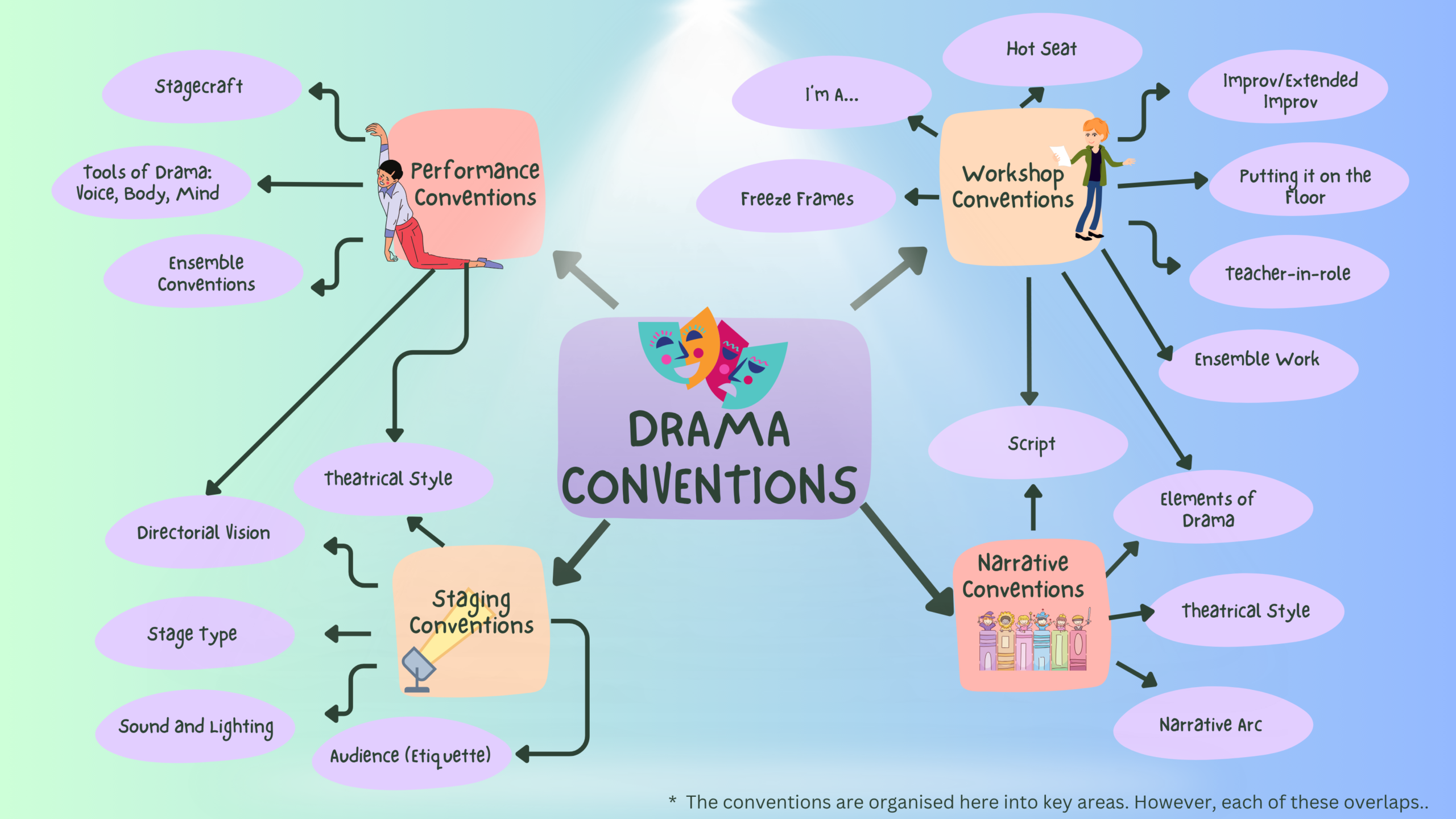
Rather than creating yet another definitive list, I’ve tried to group drama conventions into key overlapping areas: performance conventions, workshop conventions, narrative conventions, and staging conventions. Importantly, these areas are less about locking things in, and more about giving us clarity and shared language for what we already do instinctively. They also might be handy for discussions with our students.
Let’s look closer:
Performance conventions sit closest to the actor at work. These are about how meaning is embodied and communicated: the tools of voice, body and mind, ensemble awareness, and stagecraft choices that shape a performance. When students are rehearsing and presenting, they are working solidly in this space.
Workshop conventions are the bread and butter of drama classrooms. Hot seating, teacher‑in‑role, putting it on the floor, freeze frames are all the strategies we use to generate ideas, explore character, and think through drama by doing drama. These are not always visible in the final performance, but they are essential to getting there.
Narrative conventions focus on how stories work theatrically. Narrative arc, theatrical style, script, and the elements of drama (tension, focus, mood, time, place, symbol) live here. This is where students shape meaning over time by deciding what story is being told, how it unfolds, and why it matters.
Staging conventions zoom out to the bigger picture of presentation. These converntions all influence how an audience experiences the work. These conventions remind students that drama doesn’t exist in a vacuum; it exists in space, in a shared space.
Of course, none of these areas operate in isolation. A freeze frame can be a workshop tool, a performance moment, and a narrative device all at once. A lighting decision can reinforce story, style, and mood simultaneously. The overlaps matter, but having categories helps us talk about what kind of thinking we’re asking students to do.
My diagram isn’t intended to tell you what’s most important. It’s about naming what we already know, use, and teach, so that we can be more deliberate, more consistent, and maybe a little kinder to ourselves when the curriculum casually asks us to “use a range of drama conventions.”
Because now, at least, we have somewhere to start the conversation. What do drama conventions mean to you?
Katrina Cutcliffe
Excellent resource 🙂